–
days
The sport. The cards. The community.
Follow the wrestlers. Collect their cards. Step into the ring.
New here? Start with a free practice battle →Same ring. Different journeys.
There’s a reason to return. Even between tournaments.
Original animated series
Fifteen days. Six hundred rikishi. Call the bouts, open packs, and fight with cards that move with the real results — a free sumo card game, no account needed.
As on the real banzuke, the size of a name is its rank. White stars are wins, black are losses.
Creators who stream and talk sumo. Watching a basho with a crowd beats watching alone.
During a basho, these are the day's real top matchups. Between tournaments, a fresh training card (keiko) drops every day. The salt is real either way.
Before the first bout, call the whole tournament — who lifts the Emperor's Cup, who takes Fighting Spirit, which maegashira surprises everyone, and whether each yokozuna and ōzeki gets his eight. Locked when day 1 starts. Settled when the cup is handed over.
Scores start fresh each tournament. This board counts settled bout calls and basho predictions. Joining earlier gives more chances to score during that tournament; lifetime XP and card purchases do not count here.
Rank up the way a rikishi does — by turning up and calling bouts. Quests refresh every day at midnight in Japan, and everyone in the world gets the same four.
Sign in to start climbing the banzuke.
Turn up each day for a pinch of salt. Miss one and it resets — no penalty beyond starting again.
The same career file the site keeps for every rikishi, kept for you. Records, favourites, and a timeline built from what you have actually done.
Collect a few rikishi and your stable will show here.
Your highest-levelled card takes this spot.
Pin up to five cards here — shift-click any card in your collection.
Three ways to climb: Daily counts that tournament day’s settled calls. This basho counts settled calls and predictions for the current tournament. All-time XP celebrates your whole journey, including progress earned before this basho. Your cards and player level carry on between tournaments.
A fresh score each tournament. Joining partway through means fewer scoring opportunities this time; you can still make upcoming daily calls. Whole-basho predictions close when day 1 starts.
Lifetime XP rewards time spent here. Established players have a head start on this board; it is separate from the tournament competition.
The pool is all of professional sumo — 600+ rikishi across six divisions. Most pulls are lower-division commons, exactly like the real banzuke; a yokozuna is a 1-in-100 tier. When the real wrestler wins, your card gets stronger.
Illustrated wrestlers, Japanese print textures, and clear battle stats. Original fictional character artwork; names and stats come from the existing roster. A foil finish is a visual treatment. Duplicate pulls level a card up (+1 to every stat).
Every duplicate crumbles into clay — the same clay the dohyō is built from each basho. Press enough of it and you can name the rikishi you want instead of hoping for him.
Cards that change how a bout is fought rather than who fights it — the salt, the fan, the judges' call. Bought with the same clay, equipped three at a time. None of them is a wrestler, and none of them can be pulled from a pack.
Ten original DOHYŌ characters — our own mythology, never found in packs. Each one is earned by a feat, and the later ones ask a lot. Foil by birthright.
Offer any card you own for any card you want. The swap runs server-side in one step, so nobody can take a card without giving one.
Pick three of your cards, then fight. Each round compares one discipline — power, technique, or balance — with a little chaos, the way real sumo works. Win the majority to take the bout.
Every rikishi lives, trains, and eats in a heya — and never fights a stablemate. Tap any wrestler to open his profile. Sorted by strength of roster.
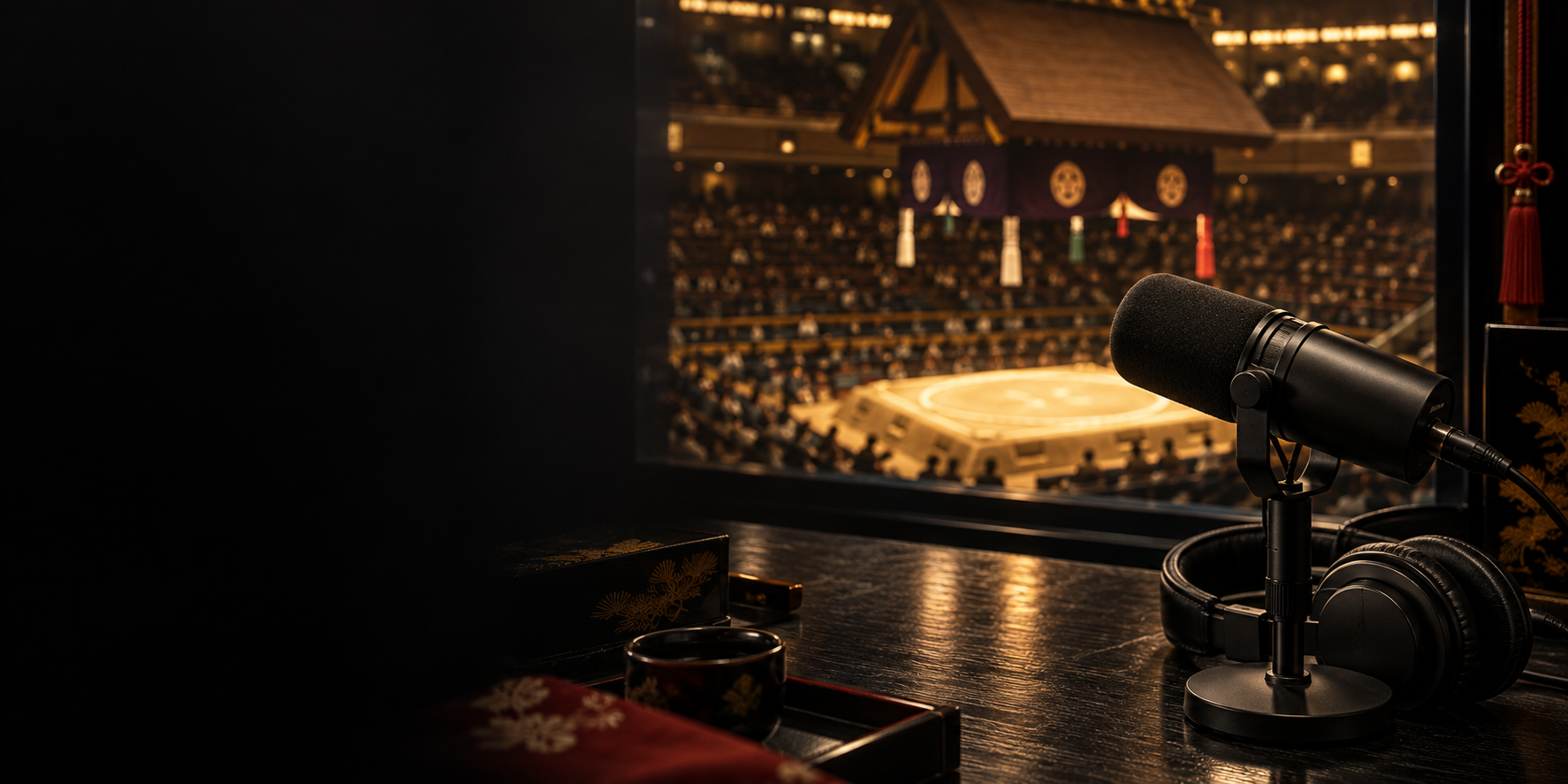
Six tournaments, four buildings. Wherever it is held, the same ring is built from clay by hand and the same tsuriyane — a Shinto shrine roof — is hung above it, its four tassels standing for the seasons and the four directions.
The rest of the year Put every basho in your calendar ↓
News, talk, and streams — the teahouse outside the arena. What the sumo world is arguing about today.
The day's bouts, from the people who filmed them — the Association's own channel and NHK World. They play here from YouTube, so the view counts for them.
Between tournaments this is most of what happens in sumo: men stop, and boys start. Retirement dates come from the Sumo-API record, not from a name going missing.
Not a recipe — a kitchen. Chanko is anything cooked and eaten in a stable; the hot pot everyone means is chanko-nabe. The junior wrestlers cook it, every day, as part of their training. Here is what goes in it, why, and how to make a pot of it yourself.
Every stable’s chanko is different, because chanko is a method rather than a dish. What varies first is the base, and there are three.
Salt. The lightest of the three, and the one that lets the stock and the seafood do the talking. A house that simmers its broth for half a day tends to use it.
Soy. Darker, more aromatic, deeper in the savoury register. The most common starting point, usually over a chicken-bone stock.
The heaviest, and the one that stands up to pork and to a big pot of chicken. Miso goes in last, off the heat — boiled miso loses its aroma.
Kirishima Kazuhiro — a Kyūshū man who reached ōzeki, and now runs a chanko restaurant in Ryōgoku under his elder name, Michinoku. His house soup breaks the usual rule of picking one base: it is soy and miso together, over a stock of chicken bones and pork bones — because tonkotsu is what his part of Kyūshū cooks with. A wrestler’s chanko tastes of where he grew up.
This is the only wrestler named on this page. Individual favourites are barely documented in English, and a made-up one about a real person is not worth the paragraph it fills. If you know a sourced one, tell us and it goes up.
Serves four. A soy-and-miso base, chicken meatballs, and whatever else is in the fridge — which is the honest version of every stable recipe there has ever been.
Nobody throws the soup away. When the pot is down to broth, the last course goes in: udon straight into what is left, or rice and a beaten egg for a zōsui. It is the best part of the meal and it is the part every stable agrees on.
The yakitori sold at the Ryōgoku Kokugikan is not brought in. The building has its own yakitori skewer factory in the basement — grilled underneath the arena, on the same day, and carried up to eleven thousand people sitting above it. Chicken again, and for the same reason.
Beer and sake were once as much a part of a stable meal as the pot itself, and a great deal of sumo’s reputation was built at those tables. That has changed: stables have moved away from heavy drinking, and plenty of wrestlers do not drink at all.
The one drink that is actually part of the sport is not alcoholic. Chikara-mizu — power water — is offered on a ladle to a wrestler before he fights, by the winner of the previous bout on his side. He rinses, spits, and takes the paper. A man who has just lost may not hand it over: you take your strength from someone who has just won.
Recipe quantities from Sudachi’s chanko-nabe. Stable custom, the shime and the two-legs reasoning from Just One Cookbook; the daily pattern and calorie range from Japan Travel Planning; the soup bases from Magical Trip; Kirishima’s house soup from Umami Bites; the basement skewer factory from the Ryōgoku Kokugikan entry on Wikipedia.
Everything a new fan needs, from your first bout to arguing about ōzeki promotion math. No gatekeeping on the dohyō.
Or skip straight to step three. On the bout screen there is a button marked 出稽古 Degeiko — training at a stable that is not your own. It lends you three cards for the day, the same three every player gets, so you can fight a bout before you have opened anything. The bout itself settles nothing — no salt either way, and nothing goes on your record — but it still counts toward today's challenge, so your first fight is not wasted.
After that it runs itself: four challenges a day, a bit of salt for turning up, and cards that get stronger as the wrestlers on them win. If you know nothing about sumo, Sumo 101 further up this page assumes exactly that.
Every way salt is earned:
Everything on that list except pack-opening and battles is paid by the server, not your browser, so it is worth the same to everyone and cannot be talked into paying twice.
Every pack's odds, published in full:
The dearer pack has better odds, but every pack is bought with salt you earned — no pack, and no salt, has ever been purchasable with money. Duplicates are never wasted either — see My duplicate cards below.
So yes: your cards move with the sport. When the real wrestler wins, the card you are holding gets better. A foil is worth +2 to all three, and every level adds +1 more, which is how a beloved lower-division common ends up outfighting somebody's ōzeki.
A ranked bout is the same thing against a real player from the leaderboard — the game picks their three strongest cards to defend with, so you are fighting their best, not a team they arranged.
A degeiko bout (出稽古) is the third kind, and the odd one out: the three cards are lent to you rather than owned, everybody is handed the same three that day, and nothing is at stake — no salt either way, nobody gets tired, nothing goes on your win-loss record, and it does not use up one of your three paid bouts. Today's challenge still counts it, and winning one is worth a badge. Since the cards are supplied, a collection is worth nothing in it. It is the fight on its own.
Which discipline each round compares is not simply luck any more — that is what the chaya cards are for. See below.
Four things keep that from being punishing:
The three-a-day cap is there for a plain reason: without it, a strong collection is an unlimited salt machine, and everything you can buy stops meaning anything.
It heals completely at midnight in Japan — the same clock the daily challenges and the basho lock run on. A tired wrestler is bruised, not ruined: fatigue stacks to a limit, never touches the card's level, and is gone by the next morning. The point is that losing costs you something today without costing you anything permanently, so you are never afraid to field your best three.
Two chaya cards deal with it directly — Kyūjō 休場 takes no fatigue from a loss at all, and Chanko-nabe ちゃんこ鍋 clears it from your three whenever you win.
On top of that there are four daily challenges, drawn fresh at midnight in Japan. Everyone in the world gets the same four on the same day, so nobody can reroll for easier ones. Either way, there is salt to earn every single day.
Each level costs a little more than the last, so Sekitori arrives quickly, Ōzeki takes about a year of turning up, and Yokozuna is meant to be a long haul. It is a record of attendance and judgement, not something that can be rushed — and none of it is purchasable.
Levels cap at 25, and on the way a card passes through three grades that change how it looks:
Clay is the answer to the oldest complaint in card games — I keep pulling men I already have. Take it to the Forge and press the exact rikishi you want instead of hoping: 18 土 for a common, 30 uncommon, 54 rare, 90 epic, 165 for a legend — and a duplicate crumbles into 6 土, or 18 once the card has nothing left to gain. It is slow on purpose. The point is that a bad run of luck still gets you somewhere.
They do four kinds of thing:
They are bought at the Forge with clay, not with salt and never from a pack, so they cost you nothing you would have spent on wrestlers and they do not change any pack's odds. And none of them depicts a person — they are teahouse objects and ring furniture, drawn by us.
The most a loadout can do is buy back two rounds, which is a bout. It cannot make a weak three unbeatable — it can make a clever three beat a stronger one, which is the whole idea.
They are soulbound by design: a Legend on your shelf means you did the thing, not that you got lucky or turned up early. They are also the only cards on the site that are entirely ours — no real wrestler is involved.
Any card, any level: a LV 4 card trades as a LV 4 card, and its level and foil travel with it to the new owner. The only cards that can never change hands are the ten Legends.
A wishlist (up to 40 rikishi) says who you are hunting, so offers that feed it float to the top of the trading post and the Forge highlights them. Other players only ever see how many people want a wrestler — never who. There are deliberately no prices, no rates and no market: the wishlist is for finding the right trade, not for valuing anybody.
They lock the moment the first bout is fought — enforced on the server, not in your browser, so there is no waiting to see how week one goes. They settle against the official results after day 15.
One deliberate kindness: a rikishi who sits the whole tournament out is scored as no contest, not as a miss. Calling a man kachi-koshi and watching him withdraw injured is bad luck, not a bad call.
That is deliberate and it is not going to change. The moment money buys anything on the dohyō, "salt is never sold" stops being true and this stops being a game where turning up and reading the basho well is the only thing that counts. The shop pays for the domain and the coffee; it buys nothing here.
The artwork on it is all original — the Legends and the DOHYŌ mark. No real wrestler's likeness is on anything, for sale or otherwise.
The basho board (under Play) resets every tournament and counts only things the server decided — bouts it scored and calls it settled. Pack and battle salt do not count towards it. A new tournament starts a new score, but joining earlier within a tournament gives more scoring opportunities. You can join mid-basho and make upcoming daily calls; whole-basho predictions have already locked.
Every result, ranking and record comes from Sumo-API, a free community-run project that the whole site depends on — if you get anything out of DOHYŌ, support them before you support us. The card designs, the tier figures and the Legends are original work; the wrestlers' names and statistics are factual sports data.
It is free, has no ads, and always will. If it ever costs you money, something has gone very wrong.
Signed in, your cards, salt and clay are kept on the server and merged rather than overwritten, so opening the site on a second device adds to what you have rather than replacing it. Cards are never deleted by us, never expire, and cannot be lost in a bout. The only way a card leaves your collection is if you trade it away.
Signing in keeps your collection on the server so it follows you between devices, and it is required for anything involving other people: trading, the leaderboards, and the daily challenges, streak and achievements that the server pays for.
One thing to know about signing in: we email you a link rather than asking for a password, and that link has to be opened on the same device you want to be signed in on. Requesting it on your laptop and tapping it on your phone signs the phone in, not the laptop.
Below the line, in makushita and down, a wrestler is technically an apprentice. He gets an allowance rather than a salary, sleeps in a shared room, serves the sekitori, does the cooking and the cleaning, and fights seven bouts a tournament.
Above it, everything changes at once:
This is why promotion to jūryō is the moment a sumo career actually begins, and why men who spend a decade in makushita and never cross the line are spoken of with real sympathy. One rank is the difference between serving tea and being served it.
They are usually built from stock elements a stable favours, so a shikona tells you where a man trained. Ryū 竜 (dragon) runs through Tatsunami-beya. Kotō 琴 belongs to Sadogatake. Take 武 to Takadagawa. Others take a syllable from their master's own fighting name, or from a mountain, a river or a province near where they were born.
A shikona can change mid-career — on promotion, on a stablemaster's word, or to carry forward a famous name the heya wants kept alive. A man may fight as one name in makushita and another entirely as an ōzeki. Every wrestler's profile on this site lists the names he has fought under and the tournament each one changed at, because the change is often the story.
Foreign-born wrestlers get one too, and the good ones are small acts of translation — Ukrainian-born Aonishiki's name carries the blue of his home flag.
Gyōji 行司 — the referee. In court dress five hundred years out of date, carrying a gunbai war fan. He must point the fan at a winner immediately — even when he cannot possibly know — and the five judges at ringside may then overrule him. Gyōji are ranked exactly as wrestlers are, promoted slowly up a ladder of their own, and the top two inherit the names Kimura Shōnosuke and Shikimori Inosuke from their predecessors. The most senior carry a dagger, historically a pledge to resign by their own hand if they call a bout wrong.
Yobidashi 呼出 — the callers. They sing the wrestlers' names up in a high carrying voice, sweep the ring between bouts, carry the sponsor banners, beat the drum that opens and closes the day — and build the dohyō itself, by hand, from clay, before every tournament.
Tokoyama 床山 — the hairdressers. They dress every wrestler's chonmage daily, and tie the ōichō — the ginkgo-leaf fan that only sekitori may wear — for tournament days. It is a full apprenticed profession with its own ranks, and a wrestler's last act on retirement is to have that knot cut off in front of an audience.
A yokozuna does his own, alone, after the rest — the only ceremony in sumo built for one man. He wears the white rope (tsuna) around his waist and is flanked by two attendants: a tachimochi carrying a sword, and a tsuyuharai, the dew-sweeper, clearing his path.
There are two styles, and a yokozuna picks one on promotion and keeps it:
The mawashi he actually fights in is a different object entirely — plain silk for sekitori, cotton below, and nothing decorative about it.
The bouts are exhibitions and nobody's record moves, which is exactly what makes them worth attending. Wrestlers who would never speak during a tournament pose for photographs, sign, and let children push them around the ring. There are demonstrations of the techniques, comic bouts, and a jinku — sumo folk singing — which is not a thing you would guess existed from watching a honbasho.
For most of Japan this is the only sumo that ever comes to town, and for the wrestlers it is the part of the job that pays the stable's bills between tournaments. It is also where injuries are nursed and where a man quietly finds out whether his body will hold for another basho.
A wrestler does not sell his own. Originals are given — to patrons, to his fan club (kōenkai), to people the stable wants to thank. Selling them himself runs against Association norms. So an original is a gift, and its value to the person holding it is mostly that it was given.
What you can buy is a printed replica, and there is nothing shady about that: the Kokugikan gift shops sell them cheaply, and specialist dealers and auction sites carry them too. Telling the two apart is the skill:
Provenance is worth caring about, because fakes exist and because "authentic" is used loosely by sellers who cannot say where a piece came from. If a listing will not tell you who was given it and when, treat the price accordingly.
You will not find tegata reproduced on this site. Not because the replicas are improper — they plainly are not — but because a tegata is a handprint and a signature, and a signature is the one thing about a living wrestler that is not sports data. Names, ranks and records are facts anyone may publish. A man's own mark is his. The same reasoning keeps faces off the cards and keshō-mawashi photographs — which carry sponsors' trademarks — out of the site entirely.
Kenshō 懸賞 are the banners carried around the ring before a bout — one per sponsor, paraded by the yobidashi. Each one is real money, and the winner takes the envelopes handed to him by the gyōji on the fan. A marquee bout between two popular men can carry dozens, which is why you sometimes see a wrestler walk off with a fistful of them.
An animated series about the bottom of the ladder. Ten episodes to a season, and each one ends with a Legend being earned — the same ten Legends you can hold as cards.
Teaser · 15 seconds · in production
One boy. One stable. Ten legends.
Before a professional bout a wrestler takes a handful of salt and throws it onto the clay. It purifies the ring. It is not for luck; salt does not care who wins.
Only the top two divisions are allowed to throw it.
Everyone below — and that is most wrestlers, for most of their careers — bows, fights, and gets off the clay for the next pair. No salt. No silk belt, no decorated apron, no ginkgo leaf in the topknot.
So the show is about the bottom of a ladder, told by people who are further up it. At the bottom of sumo, even salt has to be earned.
A season is ten episodes, and each one is the story of one of the ten Legends — the original characters on this site who are never found in packs, never pressable at the Forge, and never tradeable.
You earn them by a feat rather than by luck, and the later ones ask a great deal. Episode one’s is the gentlest of the ten: open ten packs.
A fifteen-year-old walks two hundred kilometres to a stable that does not want him, and finds that the thing he came for is not a trophy or a title. It is permission — permission to do one small thing that everybody above him is allowed to do and he is not.
He is in jonokuchi, the lowest division there is. So the salt is the one thing in the building he can see, smell and stand next to every single day, and is forbidden to touch.
About seven minutes · 14 scenes · in production. No date yet; when there is one it will be here and in the chaya.
Nine speaking parts. Three of them are already cards — Tetsuzan, Yukigumo and Onikaze are three of the ten Legends, and you can earn all three today.
The rest belong to the stable: the boy, the one who keeps flattening him, and three people who each teach him a different thing and disagree about all of it.
Shiomaru means, roughly, salt child. He has named himself after the one thing he is not allowed to have.
Printed to order and posted from the printer. Checkout happens on our Fourthwall storefront — this page is just the window.
DOHYŌ is free and always will be — no ads, no accounts required, and salt is never for sale. If the site has been useful during a basho, a small tip covers the domain and keeps it that way. A cup of sake, or a coffee; we're not fussy.
Tips buy nothing in the game — no salt, no packs, no cards. That's the point. A share of anything received goes to Sumo-API, the free community project every result on this site comes from — you can support them directly here, and honestly, do that first.